Description
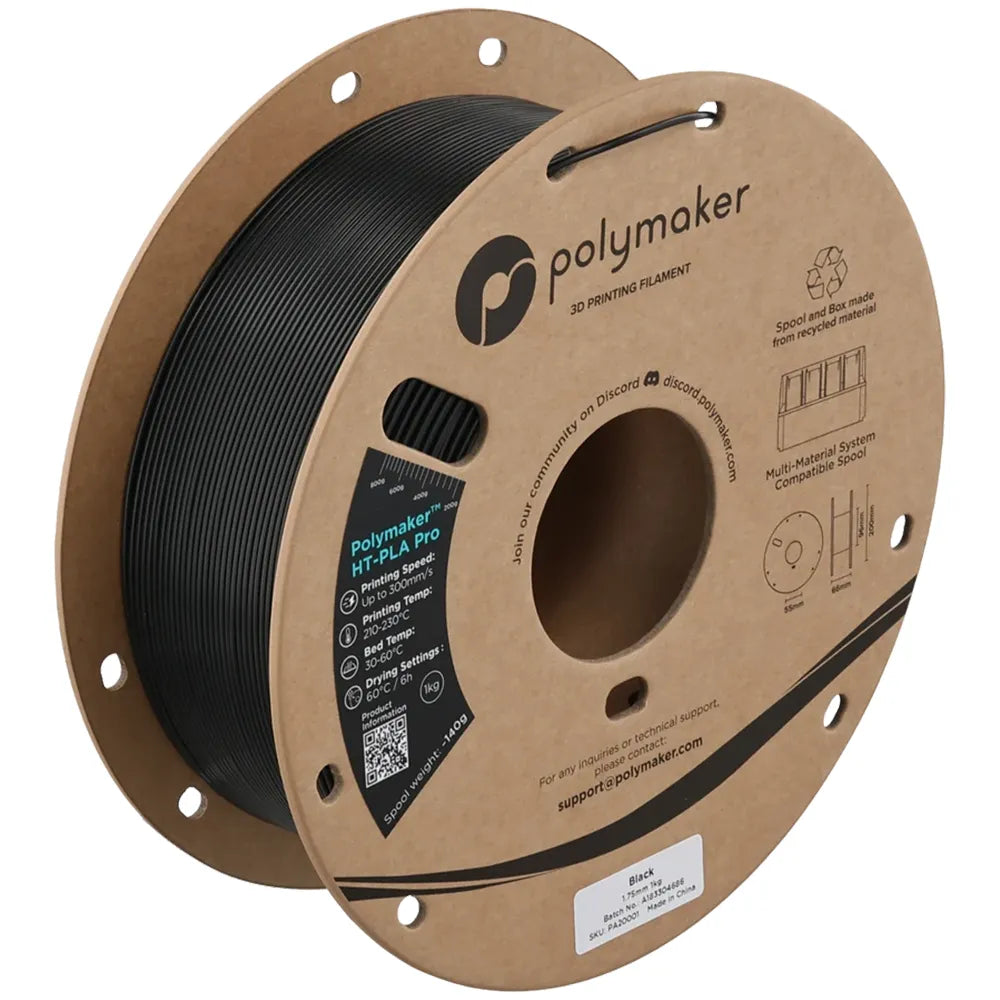
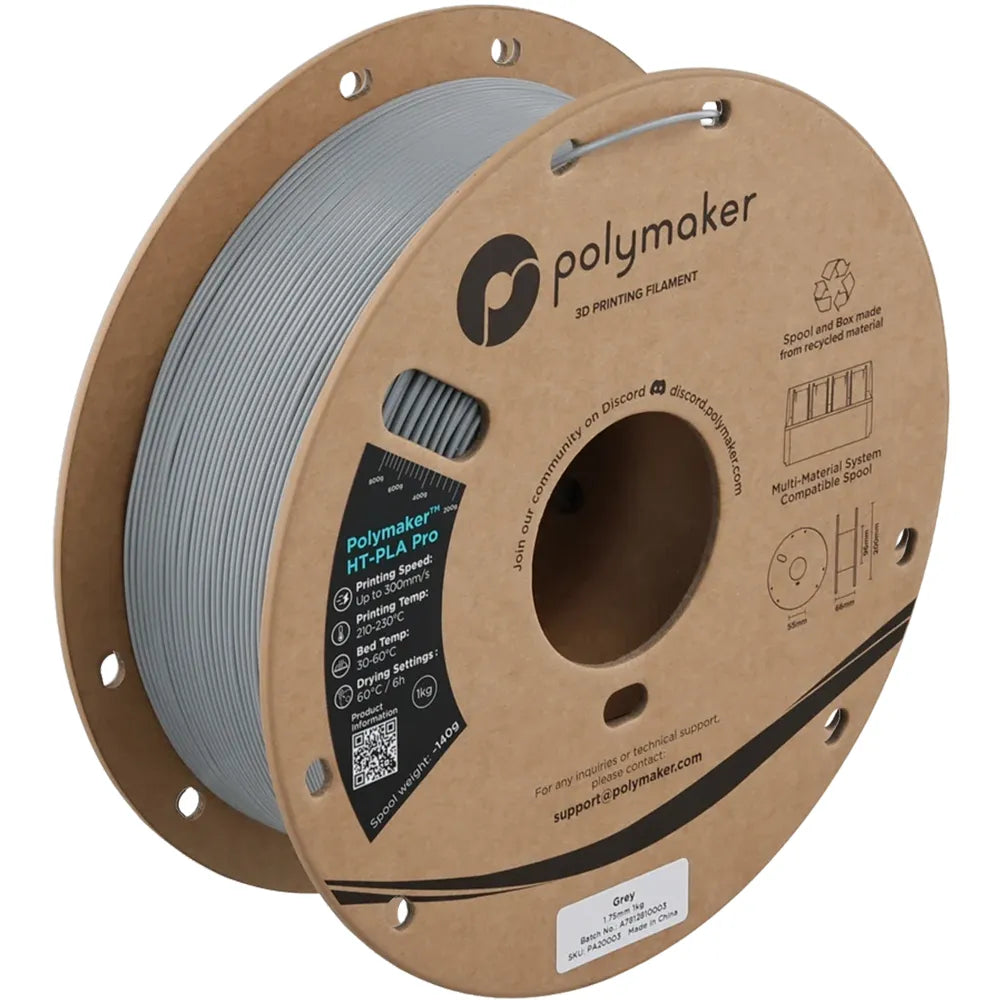
Polymaker HT-PLA Pro is a tough PLA filament for functional prototypes, housings, brackets, jigs and fixtures. It combines the familiar PLA printing workflow with improved impact strength and layer bonding compared with Polymaker HT-PLA. Choose Black or Grey, 1.75 mm, 1 kg.
Key benefits
- Around twice the notched impact strength of HT-PLA: 9.94 versus 4.94 kJ/m² in X–Y.
- Stronger layer bonding, with Z-axis tensile strength of 26.8 MPa.
- 3D printing speeds up to 300 mm/s with suitable hardware and settings.
- A standard brass nozzle is sufficient; no enclosure is required.
- Finished parts can be annealed to improve heat resistance under load.
HT-PLA Pro vs HT-PLA
Pro offers higher impact strength and improved strength between layers. This is useful for parts that are assembled, handled frequently or exposed to impacts. Compare it with Polymaker HT-PLA for your application.
| Property |
HT-PLA Pro |
HT-PLA |
| Notched Charpy, X–Y |
9.94 kJ/m² |
4.94 kJ/m² |
| Tensile strength, Z |
26.8 MPa |
20.8 MPa |
These are typical laboratory values. Part orientation, geometry, walls, infill and print settings affect the strength of the finished part.
Heat resistance: Vicat and HDT
A Vicat softening temperature of 148.3°C does not mean a loaded part can operate continuously at that temperature. For parts exposed to both heat and mechanical load, use HDT — the heat deflection temperature at a specified load — as the more relevant reference.
| Thermal property |
As printed |
After annealing |
| Vicat softening temperature |
148.3°C |
150.5°C |
| HDT at 0.45 MPa |
56.3°C |
107.6°C |
| HDT at 1.8 MPa |
53.8°C |
68.6°C |
Anneal at 100°C. Allow 30–60 minutes for walls under 4 mm, 1–2 hours at 6 mm, 2–4 hours at 8 mm and 3–6 hours at 10 mm. Use uniform heating, let the part cool inside the chamber and check its dimensions. Expected dimensional change is around 0.3–0.6%, so test a sample first for assemblies with tight tolerances.
3D printing settings
| Setting |
Recommendation |
| Nozzle |
230°C; working range 210–230°C |
| Bed |
25–65°C |
| Build surface |
PC or textured PEI |
| Speed |
Up to 300 mm/s |
| Cooling fan |
On |
| Enclosure |
Not required |
| Direct-drive retraction |
1–3 mm at 20–40 mm/s |
| Drying if moisture is absorbed |
60°C for 6 hours |
Start with a proven PLA profile and a short temperature, flow and layer-bonding test. Match the speed to your hotend flow and required finish. At 230°C the surface is semi-gloss. Around 210°C it becomes more matte, but strength may decrease.
Suitable applications
HT-PLA Pro is a practical choice for functional prototypes, brackets, clips, housings and workshop fixtures. For parts near a heat source, check the actual load and temperature against HDT. UV resistance is similar to ordinary PLA; ASA may be a better choice for prolonged exposure to direct sunlight.
Technical specifications and storage
| Specification |
Value |
| Material |
PLA |
| Diameter |
1.75 mm |
| Net filament weight |
1 kg |
| Colours |
Black and Grey |
| Density |
1.24 g/cm³ |
| Tensile strength, X–Y / Z |
37.6 / 26.8 MPa |
| Notched Charpy, X–Y |
9.94 kJ/m² |
Keep the spool in a sealed dry box with desiccant. If needed, dry at 60°C for 6 hours. Explore the other PLA filaments for 3D printing.
Polymaker HT-PLA Pro technical data sheet — PDF (EN)
Frequently asked questions
How does HT-PLA Pro differ from HT-PLA?
HT-PLA Pro has a notched Charpy impact strength of 9.94 kJ/m² in X–Y, compared with 4.94 kJ/m² for HT-PLA. Z-axis tensile strength is 26.8 versus 20.8 MPa. These are typical laboratory values; part orientation and print settings also affect performance.
Can HT-PLA Pro withstand 150°C under load?
The 148.3°C Vicat softening temperature is not a continuous service temperature under load. HDT at 0.45 MPa is 56.3°C as printed and 107.6°C after annealing. Select the material for the actual temperature, load and part geometry.
Which print settings should I use?
Start with a 230°C nozzle, a 25–65°C bed and the cooling fan on. The stated speed is up to 300 mm/s, subject to hotend flow and part geometry. Suggested direct-drive retraction is 1–3 mm at 20–40 mm/s.
Do I need a hardened nozzle or an enclosure?
No. Use a standard FDM/FFF 3D printer for 1.75 mm filament with a standard brass nozzle. An enclosure or heated chamber is not required.
How do I anneal HT-PLA Pro parts?
Anneal at 100°C. The detailed guidance specifies 30–60 minutes for walls under 4 mm; thicker parts need longer. Let the part cool inside the heating chamber and check its dimensions: a change of around 0.3–0.6% is possible.
How should I dry and store the filament?
If moisture has been absorbed, dry at 60°C for 6 hours. Store the spool in a sealed dry box with desiccant and check flow after drying or changing the print profile.
Is it suitable for permanent outdoor use?
UV resistance is similar to standard PLA. For prolonged direct sunlight, consider ASA according to the requirements of the application.
Which colours and spool size are offered?
This product is offered in Black and Grey, with a 1.75 mm diameter and 1 kg net filament weight. The finish is semi-gloss at 230°C. Printing at around 210°C gives a more matte finish but can reduce strength.